The short answer
Size the thrusters from drag at your target speed, then let the tether set the bus voltage, because voltage drop along 300 m of tether causes more trouble than the thrusters do. A typical inspection frame with 0.25 m² of frontal area needs about 14 kgf to hold 2 knots, or about 21 kgf with a 50% margin.
- 300 m is the depth at which proven thrusters, aluminium housings and mid-range penetrators are all rated, which keeps costs down.
- Aluminium-bodied gland penetrators suit 300 m. Stainless steel bodies go deeper.
- Six 500 g thrusters add 3 kg before cables and mounts, and the buoyancy budget has to absorb it.
Designing a 300-metre ROV propulsion system
Propulsion on a 300 m vehicle is four coupled decisions — thrust, layout, power delivery and sealing — and getting them in the wrong order is what produces a vehicle that works in a test tank and disappoints at depth.
Why 300 m is a natural design point
Three hundred metres covers most port, dam, hull, aquaculture and inshore survey work, and it is the depth at which a large amount of well-proven hardware is rated: brushless marine thrusters, aluminium watertight boxes, mid-range gland penetrators. That makes it a sweet spot where a capable vehicle can be built without moving into deep-rated components and their costs.
It also means the pressure boundary is not the hard part. At 300 m in seawater the gauge pressure is about 30.2 bar. Every component in the boundary must exceed that, and the system rating is the lowest one in the chain — but 300 m parts are readily available. The hard part at this depth is power delivery down a long tether.
Step one: thrust and layout
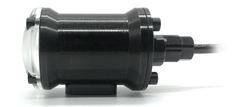
Size the horizontal thrusters from drag at the target speed, not from a catalogue. For a typical inspection-class frame of around 0.25 m² frontal area and a drag coefficient near 1.0, holding 2 knots needs roughly 14 kgf of thrust before margin, and about 21 kgf with a 50% allowance for current, tether and fouling.
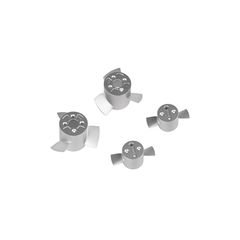
The usual layout is four horizontal thrusters vectored at 45°, giving surge, sway and yaw from one set, plus one or two vertical units for heave. Remember that a vectored unit contributes only cos(45°) — about 71% — of its rated thrust to forward motion. Four 4 kgf units at 45° deliver about 11.3 kgf forward, which is short of the 21 kgf target; either move to a larger thruster class or accept a lower speed.
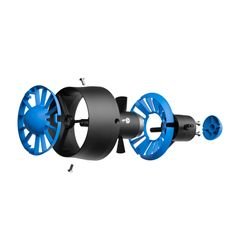
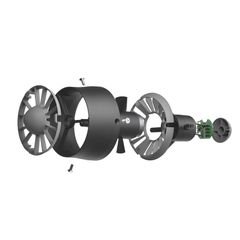
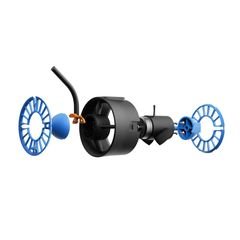
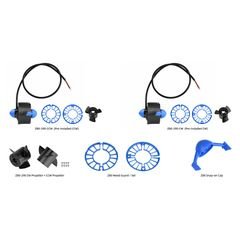
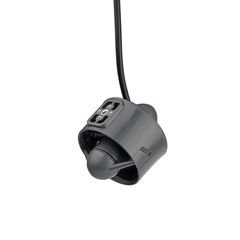
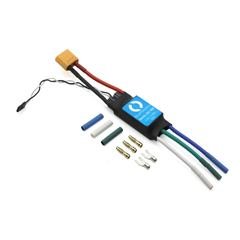
This is the point to decide between non-ESC and integrated-ESC units. Integrated puts the controller in the thruster: fewer parts inside the housing, less wiring through the bulkhead, faster to commission. Non-ESC keeps the controller inboard where it can be replaced, instrumented and chosen independently — which is what a platform expected to iterate should do.
Step two: bus voltage, decided by the tether
This is the decision that separates a 300 m vehicle from a 30 m one. Thrusters that behave perfectly on a bench misbehave at the end of 300 m of tether, and the cause is almost always voltage drop rather than the thruster.
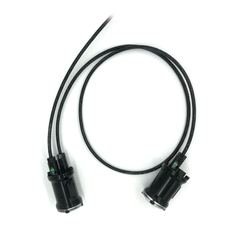
Loop resistance is R = ρ × 2L / A. Copper at 1.724 × 10⁻⁸ Ω·m, a 300 m one-way run and a 2.08 mm² (14 AWG) conductor gives about 4.97 Ω round trip. At 10 A that is roughly 50 V of drop — more than a 48 V supply has to give. The vehicle simply will not run.
There are only three levers: thicker copper, higher voltage, or less current. Thicker copper makes the tether heavy, stiff and negatively buoyant, which then costs foam. Raising the bus voltage is nearly always the right answer, because for the same delivered power, doubling voltage halves the current and quarters the loss. High-voltage down the tether with conversion on the vehicle is the standard architecture for exactly this reason.
Whatever you choose, size the conductor against the stall current of all thrusters together, not the hover current. The moment every unit spools up at once is when the bus sags and the controller browns out.
Step three: sealing the propulsion runs
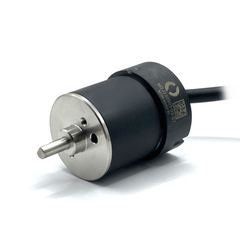
Each thruster cable is a hole in the pressure boundary. At 300 m, aluminium-bodied gland penetrators are appropriate and widely available; stainless bodies take the same threads deeper if the design might grow.
Size the gland on the cable jacket outer diameter measured with calipers, not on the conductor size. It is the most common cause of subsea leaks, and it is easy to avoid. Specify FKM rather than NBR for bulkhead seals: they see more handling than any other seal on the vehicle, and they live in saltwater with periodic solvent cleaning.
Count entries early. Six thrusters plus lights, camera, sensors and tether can exhaust an end cap quickly, and discovering it after the housing is machined is expensive. A tube coupling with its own radial ports is usually cheaper than moving up a diameter.
Step four: what propulsion does to buoyancy
Every thruster adds mass and displaced volume, and so does every metre of the heavier tether the power budget just demanded. Six thrusters at 500 g each is 3 kg of added mass before cabling, mounts and penetrators.
Track that in the buoyancy budget from the start rather than discovering it at trim. The foam to offset it has to fit on the frame, and the deeper-rated grades that a growing depth requirement might demand lift less per litre — so a late change of depth rating can cascade into a frame that no longer has room for the foam it needs.
Propulsion, power, sealing and buoyancy are one problem. Any design that treats them as four sequential purchases produces a vehicle that needs rework.
Run the numbers. The method above is implemented in our free ROV thruster sizing calculator, which states its assumptions and what it does not model.
Sources.
- Thrust, weight, voltage and 300 m depth ratings for the Blu-Thrust Z60 and Z80 ranges, and penetrator body materials and ratings, from the manufacturer's published specifications.
- Copper resistivity 1.724 × 10⁻⁸ Ω·m at 20 °C; conductor areas per ASTM B258.
- Pressure at 300 m calculated as ρgh, with 1025 kg/m³ and 9.80665 m/s². NOAA explains the relation in how pressure changes with ocean depth.
Published 16 August 2026. Last revised 25 September 2026. Corrections to sales@vebixautomation.com.
Building a 300 m platform?
Send the frame dimensions, target speed and tether length. We will reply with a propulsion set, the conductor size to feed it, and what it does to your buoyancy. Ask for a quote.
More on underwater robotics
- Underwater and ROV thrusters in IndiaBlu-Sub and Blue Robotics underwater thrusters for ROVs, AUVs and USVs, with prices in rupees and delivery across India included.
- How to choose an underwater thruster for an ROVHow to choose an underwater thruster for an ROV by thrust, voltage, depth rating, ESC, rotation and mounting.
- How to size an underwater thruster for an ROVSize ROV thrusters from drag, target speed and vectoring angle. Worked method for thrust per unit, thruster count and the margin real vehicles need.
- Aluminium versus acrylic subsea enclosuresAluminium and cast acrylic subsea housings compared on depth rating, optical access, heat, servicing and cost.
- Selecting a subsea enclosure for marine research payloadsHow to choose a subsea enclosure, end caps, seals and penetrators for research payloads, and how to test them before fieldwork.
- Subsea pressure and depth conversion guideConvert depth to pressure in bar, psi, MPa and atmospheres. Reference table, the formula behind it, and how depth ratings and test pressures relate.