The short answer
Choose the tube for how deep it goes and how often it is opened: cast acrylic is transparent, but its rating falls from about 250 m to 20 m as the tube gets larger, while anodised aluminium holds a higher rating. Use FKM O-rings rather than general-purpose NBR for long saltwater deployments, and pressure-test the housing before every field trip.
- NBR swells and degrades faster than FKM in long saltwater immersion and in sunlight.
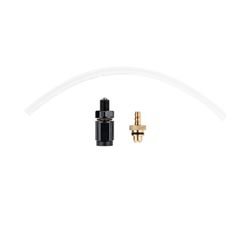
- A bulkhead pressure testing tube checks a single penetrator or plug on its own.
- An electronics tray keeps boards off the bore wall and clear of the O-ring grooves.
Selecting a subsea enclosure for marine research payloads.
For a one-off demonstration, an enclosure only has to keep water out for an afternoon. A research payload that goes back in the water again and again is a different matter: depth rating, material, seal compound and internal layout decide whether a season of data survives its own hardware. This guide covers choosing a subsea enclosure for ROV-mounted and fixed sensor payloads, from the tube material through to testing before fieldwork.
Depth rating and material.
Start with the tube, and think about how often it will be deployed as well as how deep. A subsea acrylic pressure vessel tube is machined from cast PMMA and is fully transparent, but its depth rating falls as diameter and length go up, from roughly 250 m down to 20 m depending on size. A subsea aluminium pressure vessel tube gives up the transparency for a flat 1,000 m rating, better resistance to UV and to the solvents used to clean off biofouling, and enough thermal conductivity to carry heat away from compute inside the housing.
The end caps depend on whether the payload needs to see out. A camera, light sensor or other optical instrument needs a window. A subsea acrylic end-cap is a cheap, workable choice for shallow, short jobs, but tightening it against the same acrylic face over and over can dent or crack it, so it suits housings you rarely open. For wide-angle or gimbal-mounted cameras, a subsea optical dome end-cap in cleanroom-moulded polycarbonate cuts the distortion and drag of a flat window. Where you need high optical throughput and frequent servicing, a subsea optical glass flange end-cap combines a hardened borosilicate window (about 95% light transmittance) with an aluminium flange that stands up to far more service cycles than acrylic.
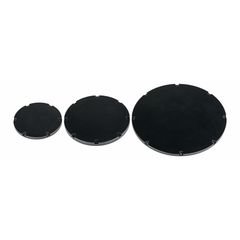
If the payload doesn't need to see anything (data loggers, CTD strings, hydrophone arrays), use a blank cap and save the cost of a window. A subsea aluminium end-cap comes blank or pre-drilled in M8 or M10 patterns for several cable runs through one cap. For shallow, clean water, where weight and corrosion matter more than depth margin, an injection-moulded subsea polymer flange end-cap combines the flange and cap in one light glass-filled nylon part. Every end cap seats against a subsea aluminium flange, which carries the double O-ring groove that makes the joint watertight.
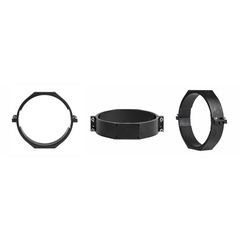
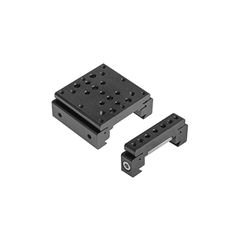
How the tube mounts to the frame depends on the material too. Secure an acrylic tube with a subsea acrylic pressure vessel clamp set. Clamping it straight onto a rigid rail, again and again, can stress the thinner acrylic wall until it cracks. An aluminium tube takes that rigidity and mounts directly on an aluminium pressure vessel enclosure mounting plate that fits the Arca-Swiss rails already common on ROV frames.
Seals: O-ring compound and gland sizing.
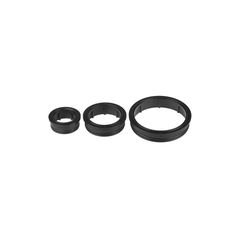
Over a deployment of months, the seal compound matters. Static face seals on flanges and end caps are usually NBR70 (nitrile), a cheap general-purpose compound that is fine in fresh water at moderate temperatures. NBR swells and degrades faster than FKM (fluoroelastomer) in long saltwater immersion, in sunlight between deployments, and in contact with biofouling solvents. Bulkhead seals on penetrator threads get handled more than any other seal on the housing, which is why they are usually FKM75. Before a long programme, order a spare O-ring set for your flange, end-cap and bulkhead sizes, and fit new rings at every service. A ring that has been compressed once never fully recovers its shape, so it seals with less margin the next time than it appears to.
Cable penetrators are the other common failure point, and the cause is nearly always a gland sized for the wrong cable. A compression gland must close on the actual outer diameter of the cable jacket, which may not match the cable on your last harness. A deep-sea M10 gland cable penetrator covers a wide range of cables in six sizes, rated to 300 m in aluminium or 1,000 m in stainless steel. A mid-depth M8 gland cable penetrator is slimmer, for tight spacing on small payload boxes. For shallow freshwater trials where cost and weight matter more than depth, a low-depth M10 gland cable penetrator has a brass and copper body rated to 100 m. Whichever you use, measure the jacket with calipers before ordering. A gland closed on a cable that is too thin leaks around the jacket, and one forced over a cable that is too thick overstresses the seal and wears it out long before the next service.
Testing before fieldwork.
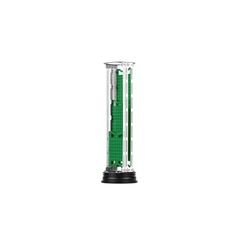
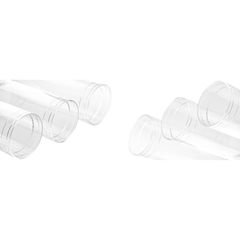
Until a housing has been under pressure, you are assuming it works. Labs that deploy repeatedly get better results by pressure testing before every trip, instead of once when the housing is new. A bulkhead pressure testing tube checks a single threaded seal, penetrator or plug on its own: you thread the part into the clear acrylic fixture, pressurise it inside a suitable chamber, and look through the tube for water afterwards. That finds a bad seal before it goes into a full enclosure, where a leak is harder to trace. To test a complete housing with its cables and connectors, a water pressure testing chamber rated to 10 MPa (about 1,000 m) with an 18-port hatch for live cabling loads the whole assembly the way the sea will.
01
Vacuum check
Pull a vacuum on the sealed, empty housing and hold it, to confirm the O-rings are seated before any water is involved.
02
Static pressure hold
Hold the housing at or above its rated depth in the chamber for a set soak time. A quick touch at the target pressure proves little.
03
Cycle test
Pressurise and release repeatedly for seals and penetrators that will see many deployments. One good hold tells you nothing about fatigue.
04
Visual inspection
Open the housing and check the O-ring seats, the desiccant and any acrylic parts for moisture, dents or stress marks before it goes to the field.
Fitting out the inside.
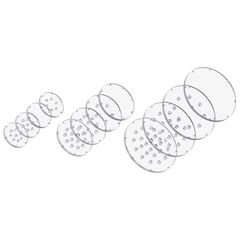
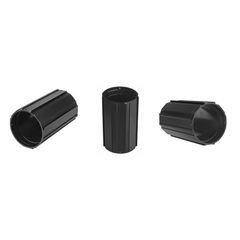
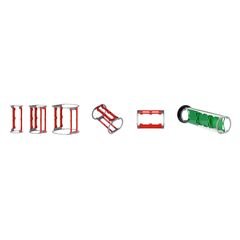
Once the housing and seals are settled, the electronics inside still need holding still against vibration and knocks, clear of the bore wall and the O-ring grooves at each end. An electronic tray set for enclosure pressure vessels gives multi-board payloads shelves sized to the tube's inside diameter, with pre-tapped holes so nobody drills in the field and leaves swarf in a sealed housing. When one insulated deck is enough, for a controller board and a small breakout say, an insulated PCB board shelf gives double-sided insulated mounting space and is handy as a layout reference while you design. For parts too large or awkward for trays and shelves, single-point enclosure tray shelf supports mount around them in less space than the double-point tray.
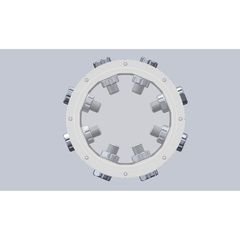
Longer sensor strings, such as several loggers, a hydrophone array, or a battery bank sharing a housing with a computer, soon outgrow one tube. A subsea enclosure tube coupling joins two 115 mm tube sections and adds sixteen radial M10 ports of its own, which takes pressure off crowded end caps. When the payload is built around a computer (a Jetson or Raspberry Pi class board) rather than a sensor string, a subsea watertight enclosure box gives you a rectangular space that is easier to fill with boards and connectors at fixed positions.
Sources.
- Depth ratings, materials, diameters and weights for Blu-Sub's acrylic and aluminium tubes, end caps and penetrators, from the manufacturer's published specifications.
- NBR and FKM behaviour in saltwater and solvents: standard elastomer selection practice.
Published 7 August 2026. Last revised 25 September 2026. Corrections to sales@vebixautomation.com.
Talk to us about your enclosure.
It is easiest to get the enclosure right the first time, before anything is machined or O-rings are ordered in the wrong compound. We sell the Blu-Sub enclosure range in this guide, and we can check depth rating, seal compound, gland sizes and internal fit against your payload before you commit. Ask for a quote.
More on underwater robotics
- Underwater and ROV thrusters in IndiaBlu-Sub and Blue Robotics underwater thrusters for ROVs, AUVs and USVs, with prices in rupees and delivery across India included.
- How to choose an underwater thruster for an ROVHow to choose an underwater thruster for an ROV by thrust, voltage, depth rating, ESC, rotation and mounting.
- How to size an underwater thruster for an ROVSize ROV thrusters from drag, target speed and vectoring angle. Worked method for thrust per unit, thruster count and the margin real vehicles need.
- Designing a 300-metre ROV propulsion systemPropulsion design for a 300-metre ROV: thruster count and layout, bus voltage, tether losses, sealing and the effect on buoyancy.
- Aluminium versus acrylic subsea enclosuresAluminium and cast acrylic subsea housings compared on depth rating, optical access, heat, servicing and cost.
- Subsea pressure and depth conversion guideConvert depth to pressure in bar, psi, MPa and atmospheres. Reference table, the formula behind it, and how depth ratings and test pressures relate.
/LR/thumb/Blu-Sub_EncIF_ShelfSupp_LR_01.jpg)