The short answer
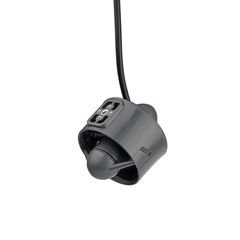
Work out the drag at your target speed with F = ½ρCdAv², add about 50% margin, and divide by the forward thrust each thruster actually contributes. A vehicle with 0.25 m² of frontal area at 2 knots in seawater has about 13.8 kgf of drag, or 20.7 kgf with margin: eight 4 kgf thrusters mounted at 45°, or four larger ones.
- Drag rises with the square of speed, so twice the speed needs about four times the thrust.
- A thruster mounted at 45° gives only 71% of its thrust in the direction of travel.
- The margin covers current, tether drag, fouling and the voltage lost along the tether.
How to size an underwater thruster for an ROV
Thruster selection guides tell you how to compare one unit against another. This is the step before that: working out how much thrust the vehicle needs, and therefore how many units to compare in the first place.
Start from drag, not from thrust
The question "how big a thruster do I need" has no answer until you have decided how fast the vehicle must move and how much water it has to push out of the way to do it. Everything else follows from that.
Hydrodynamic drag on a bluff body is F = ½ × ρ × Cd × A × v²: half the water density, times a drag coefficient, times the frontal area presented in the direction of travel, times velocity squared. In steady flight, thrust equals drag — so the drag figure at your target speed is the thrust requirement before margin.
Two of those terms are usually estimated rather than measured. Cd for an open-frame inspection ROV is typically between 0.8 and 1.2; a boxy frame with exposed cross-members sits at the top of that band, a partially faired vehicle below it. Frontal area is the projected area of the whole vehicle including thrusters, floats and anything bolted to the outside — not the cross-section of the main housing.
The square law is the part that catches people out
Drag rises with the square of velocity. Doubling the target speed does not require twice the thrust; it requires roughly four times. A vehicle specified around a comfortable 1 knot and later asked to hold station in a 2 knot current is not marginally under-powered, it is short by a factor of four.
This is why speed is the most expensive requirement on an ROV specification and the one worth interrogating hardest. A survey platform that really needs 1.5 knots of transit and 1 knot of holding authority is a very different vehicle from one specified at 3 knots because the number sounded safe.
It also means a modest speed reduction buys a great deal. Dropping a requirement from 2 knots to 1.5 cuts the drag — and so the thrust, the current draw and the battery — by about 44%.
Vectoring angle: what reaches the direction of travel
Horizontal thrusters on an inspection-class ROV are usually mounted at an angle rather than fore-and-aft, so the same four units give surge, sway and yaw authority. The cost is that each contributes only its forward component: a 4 kgf thruster at 45° pushes 2.83 kgf in the direction of travel.
That is not waste. Lateral authority is what lets a vehicle hold a line against cross-current while a camera stays pointed at the structure being inspected, and in real survey work that matters more than top speed. But it has to be in the arithmetic — sizing four thrusters against a straight-line requirement and then mounting them at 45° leaves the vehicle 30% short.
Vertical thrusters for heave sit outside this calculation. They are sized against the vehicle's out-of-trim buoyancy and the vertical speed you want, not against horizontal drag.
Margin, and what it covers
The drag equation describes a clean vehicle moving in a straight line through still water. A working ROV is none of those things. A margin of 50% over the calculated figure is a reasonable default, and it is covering four specific things.
Current. Thrust required scales with speed through the water, not over the ground. Holding position in a 1 knot current is the same hydrodynamic problem as transiting at 1 knot.
Tether drag. On a working ROV this is frequently the largest single term, and it grows with deployed length and with current across the tether. A long tether in a cross-current can dominate the vehicle's own drag entirely.
Fouling and condition. Marine growth, a damaged propeller or a partially blocked duct all reduce delivered thrust over a season.
Voltage. A thruster quoted at 4 kgf produces that at its rated voltage. Under load at the end of a long tether, the voltage at the thruster is lower than the voltage at the surface — which is a cable sizing problem, not a thruster problem, but it shows up as missing thrust.
Working it through
For a vehicle with 0.25 m² frontal area and Cd of 1.0, targeting 2 knots in seawater: v = 1.03 m/s, so F = 0.5 × 1025 × 1.0 × 0.25 × 1.03² ≈ 136 N, or about 13.8 kgf of drag. With 50% margin that is 20.7 kgf. At 4 kgf per thruster mounted at 45°, each contributes 2.83 kgf, so the vehicle needs eight horizontal units — or four larger ones.
That last observation is usually where the design converges. Eight small thrusters is a lot of penetrators, a lot of ESCs and a lot of frame; four units of roughly twice the thrust does the same job with half the plumbing. The calculation is most useful for telling you which class of thruster to be looking at, not for fixing a count.
Run the numbers. The method above is implemented in our free ROV thruster sizing calculator, which states its assumptions and what it does not model.
Sources.
- Drag relation F = ½ρCdAv², with density 1025 kg/m³ for seawater and 1000 kg/m³ for fresh water, and gravity 9.80665 m/s². NASA Glenn Research Center explains it in The Drag Equation.
- Thrust, weight and depth figures for the Blu-Thrust Z60 and Z80 ranges, from the manufacturer's published specifications.
Published 16 August 2026. Last revised 25 September 2026. Corrections to sales@vebixautomation.com.
Sizing propulsion for a build?
Send us the frontal area, target speed and depth. We will reply with a thruster count, the matching ESC and power requirement, and what it does to your buoyancy budget. Ask for a quote.
More on underwater robotics
- Underwater and ROV thrusters in IndiaBlu-Sub and Blue Robotics underwater thrusters for ROVs, AUVs and USVs, with prices in rupees and delivery across India included.
- How to choose an underwater thruster for an ROVHow to choose an underwater thruster for an ROV by thrust, voltage, depth rating, ESC, rotation and mounting.
- Designing a 300-metre ROV propulsion systemPropulsion design for a 300-metre ROV: thruster count and layout, bus voltage, tether losses, sealing and the effect on buoyancy.
- Aluminium versus acrylic subsea enclosuresAluminium and cast acrylic subsea housings compared on depth rating, optical access, heat, servicing and cost.
- Selecting a subsea enclosure for marine research payloadsHow to choose a subsea enclosure, end caps, seals and penetrators for research payloads, and how to test them before fieldwork.
- Subsea pressure and depth conversion guideConvert depth to pressure in bar, psi, MPa and atmospheres. Reference table, the formula behind it, and how depth ratings and test pressures relate.