The short answer
A fixed-wing or VTOL aircraft needs a real airspeed sensor, because GPS measures speed over the ground, not through the air: at 20 m/s airspeed, a 5 m/s headwind means 15 m/s over the ground. Choose a sensor your firmware supports on an interface you have free, I2C or DroneCAN, and design the pitot tube's position and tubing as carefully as the sensor.
- Resolution is not accuracy. Check the error specification against your airspeed range.
- Check the pitot position for disturbed airflow, and the tubing for kinks and leaks.
- Synthetic airspeed depends on estimated wind, so treat it as a backup rather than a measurement.
Choosing an airspeed sensor and pitot tube for a fixed-wing UAV
GPS speed is how fast you move over the ground. Airspeed is how fast you move through the air around you. For a fixed-wing or VTOL build, choose the sensor, the installation and the autopilot support together.
Why GPS speed is not the same measurement
NASA's relative-velocity explanation distinguishes airspeed from ground speed through the wind vector. In a simplified straight-line example, a UAV at 20 m/s true airspeed with a 5 m/s headwind travels at 15 m/s over the ground; the same tailwind gives 25 m/s. Crosswinds require vector treatment.
The example shows the difference between the two measurements. It isn't a recommended flight speed: that comes from the aircraft's design and testing. Don't size an airspeed sensor from a ground-speed figure you logged on an earlier flight.
Choose a supported sensor interface
The PX4 airspeed guide lists supported sensor families and interfaces, including I2C and DroneCAN options. Use the documentation for the firmware release you intend to install. A pressure sensor being in a catalogue doesn't mean every autopilot firmware supports that exact module.
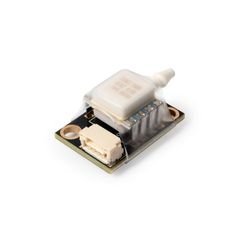
Holybro's standard digital airspeed range includes MS4525DO, MS5525DSO and AS1318C options with I2C interfaces. Its DLVR module is a separate DroneCAN product. Give the full model and interface when you ask for a quote. "Digital airspeed sensor" leaves both open.
Compare the measurement range with the actual mission
Review differential-pressure range, specified error, temperature conditions and update behaviour alongside the expected airspeed envelope. Resolution describes the electronics. It doesn't tell you how accurate the installed sensor will be. Also check supply requirements, connector pinout and the available controller port.
Take a slow research aircraft as an example. Ask the team for the smallest change in speed that matters and the temperature range of the trials, then compare each sensor's published error at those conditions. That beats picking whichever board lists the most bits.
Specify the pitot assembly, not only the sensor board
A pitot-based installation measures a pressure difference through its pneumatic connections. The pitot location, tubing and static-pressure arrangement therefore belong in the design review. Check for disturbed airflow, potential tubing kinks, leaks and an accessible route for inspection. Follow the airframe and sensor documentation for the final mounting position.
Holybro sells the sensor on its own and in PT40 and PT60 kits. Check exactly what comes in the box: pitot tube, tubing, cable and mounts. If you are only replacing the board, tell us which tube and plumbing you have, so we can check they fit before you reuse them.
Plan calibration and fault checks before flight
PX4 documents sensor selection and synthetic airspeed options. Synthetic estimation depends on estimated wind as well as ground speed; it is not a reason to treat GPS speed as a direct airspeed measurement. Configure the intended source and failure behaviour using the applicable firmware guide.
On the bench, record that the sensor is detected, the tubes are connected the right way round, the zero calibration is done and the parameters are saved. Do pressure checks only the way the manufacturer describes. Put tube inspection and blockage protection on the pre-flight checklist. A good bench reading is only the first step in validating the aircraft.
What an airspeed-sensor quotation should specify
Send the aircraft type, intended flight envelope, controller and firmware, available I2C or CAN connection, supply details, pitot location and required tube/cable lengths. State whether you need a complete assembly or a replacement sensor board.
For university and UAV teams, a brief like this keeps prototype and replacement orders consistent. Look through the Holybro sensor range with your installation drawing beside you, and write the chosen variant into the bill of materials before you order.
Sources.
- NASA Glenn: airspeed, ground speed and wind.
- PX4: supported airspeed sensors and source selection. Check the documentation for the installed release.
- Holybro: standard digital airspeed sensors, comparison and package variants.
- Holybro: DroneCAN DLVR airspeed module.
Published 5 September 2026. Last revised 25 September 2026. Corrections to sales@vebixautomation.com.
Selecting sensors for a fixed-wing build?
Send us your controller, firmware and installation details. Ask for a quote and we will confirm the right interface and pitot option.
More on drones and autopilots
- Pixhawk 6C, 6C Mini, 6X or 6X Pro: which flight controller should you choose?Compare Holybro Pixhawk 6C, 6C Mini, 6X and 6X Pro: integrated versus separate baseboard, case and variant options, and an exact-SKU checklist to order from.
- Analog, digital or DroneCAN: choosing a Pixhawk power moduleMatch a Pixhawk power module to its controller: analog sensing, I2C digital sensing and DroneCAN, plus voltage, current and wiring checks before ordering.
- Building an AI research drone: integrating a companion computer with PixhawkFit a companion computer to a Pixhawk: who does what, serial and Ethernet links, separate power, cooling and a bench-test checklist.
- Drone GPS, RTK and dual-antenna heading: which do you need?Choose drone GNSS by positioning and heading needs. Compare standard GPS, RTK corrections and dual-antenna yaw, with a Holybro sourcing checklist.
- How to choose a UAV telemetry radio: data rate, range and ground-station compatibilityChoose a UAV telemetry radio: data rate against range, a worked 915 MHz link budget, antennas and ground-station fit.
- Choosing a drone ESC: PWM, DShot, telemetry and programming compatibilityChoose a drone ESC by control protocol, telemetry path and firmware family: PWM versus DShot, BLHeli-32 versus AM32, configuration tools and troubleshooting.