The short answer
Match the power module to the way the controller senses power: an analog module such as the PM02 V3 for the Pixhawk 6C and 6C Mini, an I2C digital module such as the PM02D for the 6X, and a DroneCAN module such as the PM08-CAN where the controller reads battery data over CAN. Then check input voltage, continuous current and measurement range separately.
- A power module measures the battery and powers the controller. A distribution board only routes power.
- Don't copy analog battery settings into a digital install.
- A large current-sensing range is not a continuous-current rating.
A power module can power your flight controller and still report the battery over the wrong interface. Treat power delivery, voltage and current sensing, and the data link as three separate checks.
A power module and a distribution board have different jobs
A distribution board routes battery power to the loads. A power module adds a regulated supply for the controller and measures the battery, and some designs do distribution as well. Start with a wiring diagram showing the battery, motor loads, controller and payload supplies. It shows which board has to do what.
The main decision in this guide is how the measurements reach the flight controller. A connector that fits is only the first check. The controller also has to understand the signals and have the right battery-monitor settings.
Analog sensing: match the controller inputs and scaling
Analog modules report the battery as scaled voltages. Holybro's analog setup guide covers battery-monitor configuration and the controller-specific inputs used by models including Pixhawk 6C and 6C Mini. Voltage and current scaling must match the module.
When you replace a module, write down the old part number and settings before you take it out. On the bench, compare its readings with a separate meter. A sensible battery voltage on its own does not prove the current sensing is wired and scaled correctly.
Digital I2C: the PM02D needs its own settings
Holybro identifies Pixhawk 5X and 6X power sensing as digital I2C, with modules such as PM02D providing that interface. Its digital setup guide distinguishes low- and high-voltage versions and their sensing hardware. Check the exact module revision and the firmware it supports. Don't copy settings across from an analog installation.
A useful replacement request reads: 'Pixhawk 6X, current firmware version attached, photo of the existing PM02D label, maximum battery voltage stated.' That gives a supplier enough to check compatibility. 'Six-pin power module for Pixhawk' does not.
DroneCAN: identify the sensing link and the power output
Holybro lists PM08-CAN separately from its I2C digital modules in the power-module comparison. The CAN connection carries the battery data, and the regulated supply still needs its own connection. "Digital" covers both, so write I2C or DroneCAN in the bill of materials.
For a CAN installation, review the bus layout, controller support and module configuration together. Label the supply lead and the data lead on the drawing, so a harness that looks complete doesn't go out missing the lead that carries the measurements.
Check three electrical limits independently
Input voltage: compare the fully charged pack voltage with the exact module's permitted input. Current path: verify the continuous load, stated transient conditions, cable and connectors. Measurement range: check what the sensor can report. A large sensing range is not a continuous-current rating for the board.
Also add up what the controller and its peripherals draw from the regulated output. Note which loads pass through the current sensor: a payload powered separately won't show up in the flight controller's consumption figure.
What to send with a power-module enquiry
Include the controller and baseboard model, firmware, battery cell count and maximum voltage, expected continuous and transient load, connector types and required sensing interface. Attach a wiring sketch showing every power branch and whether distribution is already present.
Agree a bench acceptance record covering the voltage reading, the current reading under a known load, a stable controller supply and the saved configuration. Do these checks with the propellers off, and follow the module manufacturer's wiring instructions before you power anything up.
Sources.
- Holybro: analog power-module setup.
- Holybro: digital power-module setup.
- Holybro: module interfaces, electrical ratings and comparison. Verify the revision being supplied.
Published 5 September 2026. Last revised 25 September 2026. Corrections to sales@vebixautomation.com.
Need a compatible power module?
Send us the electrical and interface details above with the quantity you need. Ask for a quote and we will confirm the right module and wiring.
Compare the parts: Drone flight controllers and autopilots · Drone power modules and power distribution boards
More on drones and autopilots
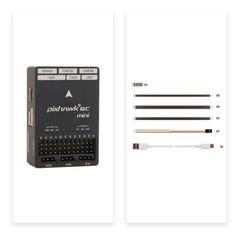
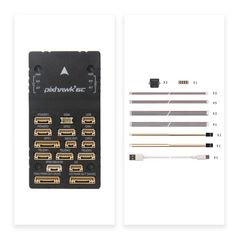
- Pixhawk 6C, 6C Mini, 6X or 6X Pro: which flight controller should you choose?Compare Holybro Pixhawk 6C, 6C Mini, 6X and 6X Pro: integrated versus separate baseboard, case and variant options, and an exact-SKU checklist to order from.
- Building an AI research drone: integrating a companion computer with PixhawkFit a companion computer to a Pixhawk: who does what, serial and Ethernet links, separate power, cooling and a bench-test checklist.
- Drone GPS, RTK and dual-antenna heading: which do you need?Choose drone GNSS by positioning and heading needs. Compare standard GPS, RTK corrections and dual-antenna yaw, with a Holybro sourcing checklist.
- How to choose a UAV telemetry radio: data rate, range and ground-station compatibilityChoose a UAV telemetry radio: data rate against range, a worked 915 MHz link budget, antennas and ground-station fit.
- Choosing a drone ESC: PWM, DShot, telemetry and programming compatibilityChoose a drone ESC by control protocol, telemetry path and firmware family: PWM versus DShot, BLHeli-32 versus AM32, configuration tools and troubleshooting.
- Holybro S500, X500 V2 or X650: choosing a drone development kit for researchCompare Holybro S500 V2, X500 V2 and X650 drone kits: wheelbase, included propulsion and avionics, frame versus ARF versus development format.

/LR/thumb/Holybro_Kakute_H7_V1_5_ICM_42688_P_01.jpg)
%20w-o%20Bluetooth/LR/thumb/Holybro_Kakute_H7_V1_5_ICM_42688_P_w_o_Bluetooth_01.jpg)