The short answer
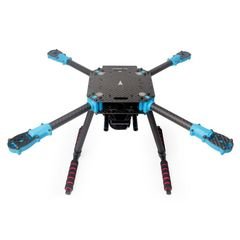
Choose the X500 V2 for a first PX4 or ArduPilot research drone, the smaller S500 V2 when budget matters more than payload room, and the X650 when the aircraft must carry a real payload or a companion computer. Decide the format first: a frame kit is the airframe alone, an ARF kit adds propulsion, and a development kit adds the autopilot, GPS and telemetry. No kit includes a battery.
- S500 V2: 480 mm wheelbase, 782 g as supplied, 2216 KV920 motors on 10-inch propellers.
- X650: 650 mm folding carbon frame, MN4014 KV330 motors on 15-inch propellers.
- Holybro recommends 4S 3,000–5,000 mAh for the S500 and X500 V2, and 6S 5,000–12,000 mAh for the X650.
Holybro S500, X500 V2 or X650: choosing a drone development kit for research
Three airframes, and several ways to buy each one. Most mistakes in a development-kit order come from choosing the wrong kit format, or forgetting the things no kit includes. The frame itself is the easy part.
Kit format decides the order before the airframe does
Holybro sells each of these platforms in three formats, and the formats differ far more than the airframes do. A frame kit is the airframe alone: arms, plates, landing gear, fasteners. An ARF kit adds the propulsion — motors, speed controllers, propellers and the power distribution. A development kit adds a named avionics set on top of that.
Choose the format by what your project is about. A lab that has already settled on an autopilot and telemetry setup should buy the ARF kit and fit its own avionics, or the development kit's flight controller just becomes a spare. A course that needs twelve identical aircraft flying by the end of term should buy development kits, because every hour spent choosing a GNSS receiver is an hour taken from teaching.
The frame kit is the right choice less often than people expect. It suits a project where the propulsion is the research: a new motor, an unusual propeller, a hybrid powertrain. Don't buy it to save money. Sourcing four matched motors, four ESCs and a distribution board separately usually costs more, and always takes longer.
Read the kit name as a specification
A development kit's name is really a bill of materials. "X650 Development Kit (Pixhawk 6X/M10/915MHz)" tells you three things: the autopilot is a Pixhawk 6X, the GNSS receiver is an M10, and the telemetry radio is the 915 MHz variant. Each has a 6C or 433 MHz sibling under a different SKU.
One thing to check before you order. Holybro's current listings describe the kit's SiK V3 radio as selectable between 433 MHz and 915 MHz, while we list the kits as separate part numbers for each frequency. Both can be true of different batches, and we won't guess which you would get. Ask us to confirm the radio in the exact kit we quote, and get the answer in writing before you order.
The frequency matters most, because you can't change it later without buying another radio. A 433 MHz air unit won't talk to a 915 MHz ground station at any range, so a mismatched spare is money spent twice. Which band you may use is set by national regulation, and a manufacturer's product page can't tell you. Confirm the permitted band and power for your country and type of operation before you order, and keep the answer in the project file.
Choosing the autopilot inside a kit has the same consequences as choosing it on its own: a Pixhawk 6C arrives as a complete controller with fixed connectors, and a Pixhawk 6X is a compute module that needs a baseboard. Our flight controller comparison covers that branch; check whether a 6X kit includes the baseboard before assuming it does. The kit listings pair the two routes with different power modules — a 6C kit with a PM02 V3, a 6X kit with a PM02D-class digital module on a V2A baseboard — and Holybro notes that the 6X option needs SENS_EN_INA228 enabled under PX4, with ArduPilot support starting at 4.4. Plan that firmware step for day one so it doesn't surprise you in week three.
How the three airframes differ
Holybro's figures for two of the ARF kits show how far apart they are. The S500 V2 has a 480 mm wheelbase, measures 383 × 385 × 240 mm, weighs 782 g as supplied, and carries 2216 KV920 motors on BLHeli S 20 A controllers with 1045 propellers and a 60 A continuous integrated power distribution board.
The X650 is a different class of aircraft: a 650 mm wheelbase folding carbon-fibre frame with 4 × T-Motor MN4014 KV330 motors, 4 × Tekko32 F4 45 A controllers and Gemfan 1555 carbon-fibre propellers, wired XT60 for the battery and XT30 for the ESC and peripheral connections.
Compare the two propulsion sets and the payload difference is clear. A KV920 motor on a 10-inch propeller suits a light, agile airframe; a KV330 motor on a 15-inch propeller is built to lift. The X500 V2 sits between them at a 500 mm class wheelbase and is the common choice for a first PX4 research platform.
Be careful with one figure: we don't publish a payload allowance. It depends on your battery, propeller, air temperature and the flight time you need, and the reliable way to get it is a thrust-versus-current curve for that motor and propeller at your pack voltage. Ask us and we will send the manufacturer's propulsion data for the exact kit. Treat any single "max payload" number that doesn't state those conditions as marketing.
What no kit includes
Battery first, because it is the one the manufacturer states outright: no battery is included with any of these kits. Holybro does publish what to fit — a 4S LiPo of 3000–5000 mAh at 20C or better on an XT60 for the S500 and X500 V2, and a 6S LiPo of 5000–12000 mAh on an XT60 for the X650 — so the budget line can be costed accurately rather than guessed.
Apart from the battery, check rather than assume. These kits aren't sold with an RC transmitter and receiver, a charger, a ground-station computer, or your payload and its mounts, but exactly what ships can change between SKUs and batches. Ask for the packing list for the part number we quote and check against it.
The X650 ARF kit says so in its own listing — flight controller, GPS, telemetry and battery not included — and the X500 V2 ARF kit (SKU 30125) is documented as arriving with motors, ESCs, propellers and the power distribution board pre-installed, with the frame kit (30120) as the bare airframe. A development kit adds the avionics. It doesn't cover anything else on that list.
For an institutional purchase, put those items on the requisition along with the kit. An airframe that arrives without a battery can't fly, and a second purchase order usually takes longer than the first.
Assembly, and what the aircraft still needs from you
An ARF or development kit doesn't arrive ready to fly. Expect to build the frame, mount and wire the propulsion, install and configure the autopilot, calibrate the sensors and radio, set the failsafes and run a first-flight procedure. Allow days for the first one; the second is much quicker.
Choose the firmware on purpose. PX4 and ArduPilot both run on these controllers, but their configuration, parameter names and ground-station workflow are different. Pick one for the whole programme. A lab running both ends up with two sets of know-how and aircraft that can't be swapped between students.
Plan spares from the start. On a research aircraft, propellers and landing gear get used up, and arms are the next thing to break. For a teaching fleet, one spare airframe's worth of parts per six aircraft is a sensible starting point, and far cheaper than a whole class grounded while parts are imported.
Expansion: what each platform lets you add later
The two questions that decide whether a platform will still suit you in eighteen months are physical space and electrical headroom. Space for a payload and a companion computer under the centre plate; headroom in the power system for what that payload draws.
A 650 mm airframe with KV330 motors on 15-inch propellers has both. A 480 mm airframe on 10-inch propellers has much less of each, and adding a camera, a companion computer and their power uses up the margin that made it fly well. If the plan includes onboard computing (vision, mapping, autonomy), size the airframe for the aircraft you will have at the end of the project.
If you plan a companion computer, decide early, because it affects the autopilot choice: the modular 6X can sit on a Jetson or Raspberry Pi CM4 baseboard that carries both computers on one board. Our companion computer integration guide covers the responsibility split, the power arrangement and the bench tests before first flight.
What to send with a development-kit enquiry
The airframe class or the payload mass and dimensions you need to carry; the flight time you are targeting; whether you want frame, ARF or development format; your autopilot and firmware preference; the telemetry band you are permitted to use; the quantity, and whether they must be identical; and whether a companion computer or a specific payload is in the plan.
Tell us if this is an institutional purchase. University and research orders in India often need a formal quotation against a tender or grant, with part numbers, HSN codes and delivery terms. That is a different document from a price list, and it is easier to get right first time than to revise.
The three platforms and their kit formats
Every family comes in all three formats. The development-kit column shows the avionics each one is sold with.
| Platform | Wheelbase | Propulsion in the ARF kit | Development kit avionics | Frame kit | ARF kit | Development kit SKUs |
|---|---|---|---|---|---|---|
| S500 V2 | 480 mm | 4 × Holybro 2216 KV920, 4 × BLHeli_S 20 A, 1045 propellers, 60 A integrated PDB. 383 × 385 × 240 mm, 782 g | Pixhawk 6C plastic, PM02 V3, M10 GNSS, SiK V3 telemetry | 510074 | 30062 | Pixhawk 6C / M10: 30184 (433 MHz), 30185 (915 MHz) |
| X500 V2 | 500 mm class | 4 × Holybro 2216 KV920, 4 × BLHeli_S 20 A, 1045 propellers, PDB pre-installed | Pixhawk 6C plastic, or Pixhawk 6X on a V2A baseboard with a PM02D-class module. M10 GNSS, SiK V3 telemetry | 30120 | 30125 | 6C: 30188 / 30189 · 6X: 30199 (433 MHz), 30200 (915 MHz) |
| X650 | 650 mm | 4 × T-Motor MN4014 KV330, 4 × Tekko32 F4 45 A, 4 × Gemfan 1555 carbon fibre, WS2812 arm lighting. XT60 battery, XT30 ESC and peripherals | Pixhawk 6C plastic with PM02 V3, or Pixhawk 6X on a V2A baseboard with PM02D. M10 GNSS, SiK V3 telemetry | 30178 | 30179 | 6C: 30180 / 30181 · 6X: 30182 (433 MHz), 30183 (915 MHz) |
Figures are from Holybro's kit documentation (7 September 2026). Older X500 V2 documents list an M8N receiver where the current listing has an M10, so ask which is in the kit we quote. In each development-kit pair, the lower SKU has the 433 MHz radio and the higher one the 915 MHz.
Parts in this guide.
Check the exact variant and revision before you order.
Holybro S500 V2 ARF Kit
480 mm, propulsion included, avionics separate. SKU 30062.
Holybro X500 V2 ARF Kit
The usual first PX4 research aircraft. SKU 30125.
Holybro X650 ARF Kit
650 mm folding carbon frame, MN4014 KV330 propulsion. SKU 30179.
X650 Development Kit (6X / M10 / 915 MHz)
Airframe, propulsion and avionics. SKU 30183.
Holybro X650 Frame Kit
Airframe only, for a project where the propulsion is the research. SKU 30178.
All development kits
Every family and format, with each SKU.
Sources.
- Part numbers, wheelbase, dimensions, mass and ARF propulsion sets for the S500 V2, X500 V2 and X650 kit families from the manufacturer's published specifications.
- S500 V2 development kit (accessed 2026-09-07)
- X500 V2 development kit current store listing (accessed 2026-09-07)
- X650 development kit (accessed 2026-09-07)
- X500 V2 ARF and frame kits (accessed 2026-09-07)
Published 7 September 2026. Last revised 25 September 2026. Corrections to sales@vebixautomation.com.
Specifying a research platform?
Send us your payload mass and size, target flight time, preferred autopilot and firmware, the telemetry band you are allowed to use and the quantity. We will reply with a shortlist of parts that work together and a formal quotation you can raise a purchase order against. Ask for a quote.
More on drones and autopilots
- Pixhawk 6C, 6C Mini, 6X or 6X Pro: which flight controller should you choose?Compare Holybro Pixhawk 6C, 6C Mini, 6X and 6X Pro: integrated versus separate baseboard, case and variant options, and an exact-SKU checklist to order from.
- Analog, digital or DroneCAN: choosing a Pixhawk power moduleMatch a Pixhawk power module to its controller: analog sensing, I2C digital sensing and DroneCAN, plus voltage, current and wiring checks before ordering.
- Building an AI research drone: integrating a companion computer with PixhawkFit a companion computer to a Pixhawk: who does what, serial and Ethernet links, separate power, cooling and a bench-test checklist.
- Drone GPS, RTK and dual-antenna heading: which do you need?Choose drone GNSS by positioning and heading needs. Compare standard GPS, RTK corrections and dual-antenna yaw, with a Holybro sourcing checklist.
- How to choose a UAV telemetry radio: data rate, range and ground-station compatibilityChoose a UAV telemetry radio: data rate against range, a worked 915 MHz link budget, antennas and ground-station fit.
- Choosing a drone ESC: PWM, DShot, telemetry and programming compatibilityChoose a drone ESC by control protocol, telemetry path and firmware family: PWM versus DShot, BLHeli-32 versus AM32, configuration tools and troubleshooting.

/LR/thumb/Holybro_S500_V2_Development_Kit_Pixhawk_6C_M10_433MHz_01.jpg)
/LR/thumb/Holybro_S500_V2_Development_Kit_Pixhawk_6C_M10_915MHz_01.jpg)