The short answer
Net buoyancy is the mass of water displaced minus the vehicle's mass in air. A 45 kg vehicle displacing 40 litres of seawater displaces 41 kg, 4 kg short of neutral, so reaching +1 kg needs 5 kg of lift: about 8 litres of 0.40 g/cm³ foam, or 10.5 litres of a deeper-rated 0.55 g/cm³ grade.
- Aim slightly positive, from a few hundred grams to a kilogram or two, so a dead vehicle surfaces.
- Deeper-rated foam is denser, so it lifts less per litre.
- Redo the sum every time the payload changes.
Our buoyancy guide covers the engineering thinking. This one does the arithmetic, with numbers, so you can check your own vehicle against it.
The two numbers everything rests on
Net buoyancy is the mass of water displaced minus the mass of the vehicle in air. Positive floats, negative sinks, zero hovers. Everything else is bookkeeping.
Displaced water mass is the vehicle’s external volume times water density. In seawater at 1025 kg/m³, each litre displaced carries 1.025 kg. So a vehicle displacing 40 litres is being held up by 41 kg of water.
The mass figure is the easy one — put the assembled vehicle on a scale. The volume figure is where errors live, and the reliable method is not CAD. Lower the finished vehicle into a drum of water and measure the rise, or weigh it in air and again fully submerged: the difference in apparent weight is the mass of water displaced, directly.
Worked example: a vehicle that needs foam
Take a vehicle massing 45 kg in air and displacing 40 litres, working in seawater, with a target of +1 kg net buoyancy.
Displaced water mass = 40 L × 1.025 kg/L = 41.0 kg. Net buoyancy = 41.0 − 45 = −4.0 kg. The vehicle sinks at 4 kg, and to reach +1 kg it needs 5.0 kg of additional lift.
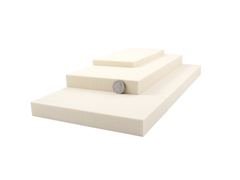
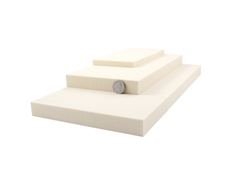
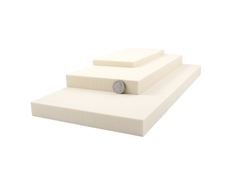
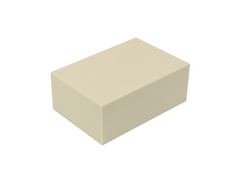
Foam supplies that lift as the difference between water density and foam density. A 0.40 g/cm³ syntactic foam in seawater lifts 1.025 − 0.400 = 0.625 kg per litre. So the foam required is 5.0 ÷ 0.625 = 8.0 litres.
Note what that 8 litres does to the other side of the ledger: it weighs 3.2 kg and displaces 8 litres, and both are already inside the 0.625 kg/L figure. That is why you divide by net lift per litre rather than iterating — the arithmetic already accounts for the foam carrying itself.
The same vehicle, one grade deeper
Now suppose the operating depth requirement moves and the 0.40 g/cm³ grade is no longer rated for it. At a denser 0.55 g/cm³ grade, lift per litre falls to 1.025 − 0.550 = 0.475 kg/L, and the same 5 kg of lift now needs 10.5 litres rather than 8.0.
That is a 31% increase in foam volume for the same result, and it has to physically fit on the frame without fouling thrusters or blocking the camera. This is the mechanism by which a late change in depth rating cascades into a frame redesign, and it is why the depth requirement should be settled before the structure is.
Why to aim positive, and by how much
Target a small positive figure — commonly a few hundred grams to a kilogram or two depending on vehicle size. A vehicle that is slightly positive surfaces on a power or thruster failure and can be recovered; one that is neutral or negative is lost.
Do not overdo it. Every kilogram of positive buoyancy is a kilogram the vertical thrusters push against for the whole dive, which costs current, endurance and thermal headroom. Choose the trim as a balance between easy recovery and endurance.
Trim also has a distribution component this calculation does not capture. Net buoyancy tells you whether the vehicle floats; it says nothing about whether it floats level. Where the buoyancy sits relative to the centre of mass sets the righting moment, and a vehicle with correct net buoyancy can still swim nose-down. Position foam high and ballast low.
Re-check it every time the payload changes
Research platforms swap sensors between deployments, and every swap changes both mass and displaced volume. A vehicle trimmed to the gram for one configuration needs the calculation redone for the next — and often more foam ordered, with the lead time that implies.
The practical approach is to keep the weight-and-displacement table as a live document alongside the mechanical design, with a line for every component. Recalculating then takes minutes rather than an afternoon with a tape measure and a drum of water.
Leave room for the next one or two payloads instead of trimming exactly for the one on the bench today.
Run the numbers. The method above is implemented in our free ROV buoyancy and ballast calculator, which states its assumptions and what it does not model.
Sources.
- Archimedes' principle, with seawater at 1025 kg/m³ and fresh water at 1000 kg/m³.
- Syntactic foam density range 0.36–0.57 g/cm³ across the 500 m to 6,000 m grades, from the manufacturer's published specifications for Blu-Float.
Published 16 August 2026. Last revised 25 September 2026. Corrections to sales@vebixautomation.com.
Want the foam sized for you?
Send the vehicle mass, displaced volume and operating depth, and we will reply with the foam grade, the volume and where to put it. Ask for a quote.
Compare the parts: ROVs and uncrewed surface vessels · Subsea buoyancy foam and ballast
More on underwater robotics
- Underwater and ROV thrusters in IndiaBlu-Sub and Blue Robotics underwater thrusters for ROVs, AUVs and USVs, with prices in rupees and delivery across India included.
- How to choose an underwater thruster for an ROVHow to choose an underwater thruster for an ROV by thrust, voltage, depth rating, ESC, rotation and mounting.
- How to size an underwater thruster for an ROVSize ROV thrusters from drag, target speed and vectoring angle. Worked method for thrust per unit, thruster count and the margin real vehicles need.
- Designing a 300-metre ROV propulsion systemPropulsion design for a 300-metre ROV: thruster count and layout, bus voltage, tether losses, sealing and the effect on buoyancy.
- Aluminium versus acrylic subsea enclosuresAluminium and cast acrylic subsea housings compared on depth rating, optical access, heat, servicing and cost.
- Selecting a subsea enclosure for marine research payloadsHow to choose a subsea enclosure, end caps, seals and penetrators for research payloads, and how to test them before fieldwork.